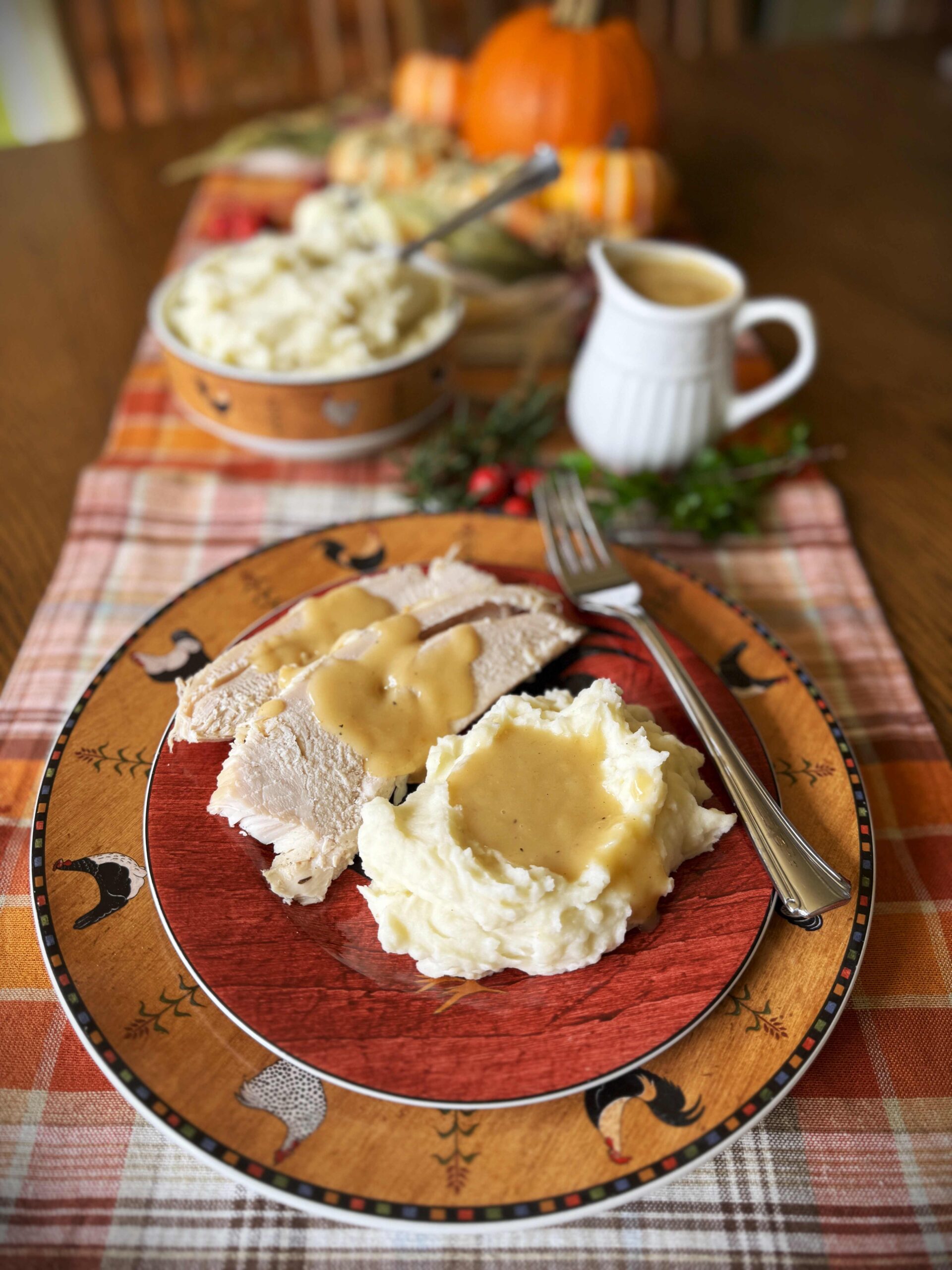
Usually, people say “mashed potatoes and gravy,” but in this case, gravy is the star. This is nothing like your powder packet/open a jar variety of gravy, but the good kind—the kind Grandma used to make. And the kind YOU can make, after this short lesson.
If you already know how to make delicious gravy from scratch, yeah! But many people don’t, so I’m posting this as a PSA to save my fellow Americans from suffering through another Thanksgiving of subpar gravy. There are many ways to make gravy, but this is the way I’ve done it for decades. And my family wouldn’t want me to make it any other way.
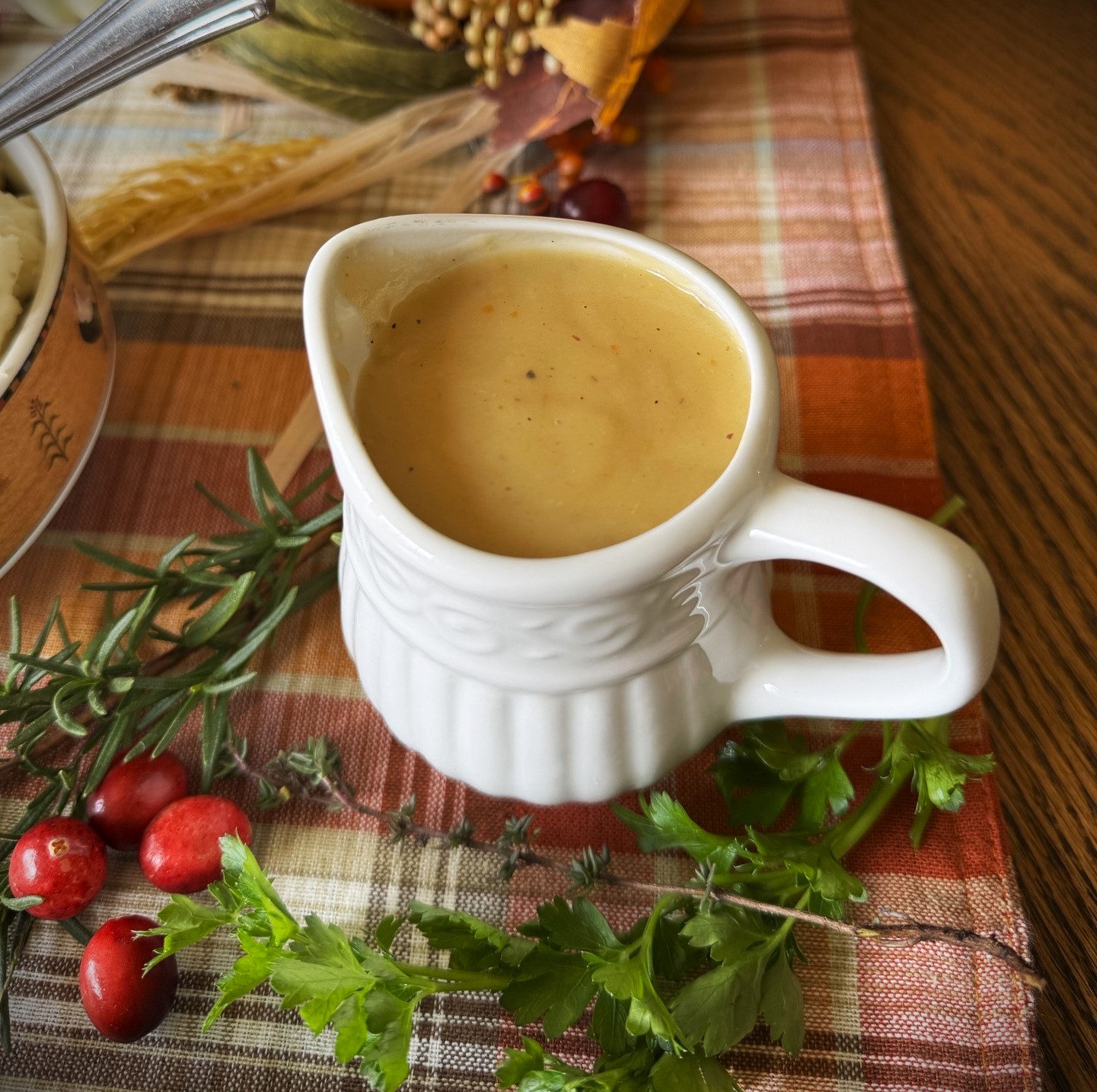
The key to a great gravy is the stock used to make it. I can’t emphasize this enough. My stock comes from the juices and drippings of a brined and well-seasoned turkey I roast in a oven bag. I surround the bird with LOTS of celery, onions, garlic, and carrots, along with plenty of fresh herbs: rosemary, flat-leaf Italian parsley, sage, and thyme. I’m blessed with a herb garden, and these plants are still hanging around in late November.
Roasting it in an oven bag helps me save every drop of tasty goodness without the stock evaporating away. If you find you come up short in how much stock you’ve managed to create, you can always supplement with boxed chicken stock. You can also take the leftover turkey carcass and simmer it in chicken stock (or boxed turkey stock if you’re lucky enough to find it), along with more veggies, and make even more stock.
I use a roux to make my gravy, which is a cooked mixture of equal parts flour and butter. My gravy equation is quite simple: 1/4 cup butter and 1/4 plain flour will thicken 2 cups of broth. Master that, and you can be a gravy goddess.
Homemade Gravy
In a skillet, melt 1/4 cup butter on medium heat. Stir in 1/4 cup plain flour. Stir the roux around with a spatula for about one minute to let the starchiness cook out. The longer you cook the roux, the less thickening power it has. This method makes a “blond” roux, which has the most ability to thicken. (Some recipes, like Cajun ones, call for a darker roux.)
Once the roux is cooked, pour in 2 cups of quality stock. Stir. Keep stirring. If it looks weird at first, even slightly separated and lumpy, no worries. Just keep stirring. It will soon come together and begin to thicken. You won’t know how thick it will get until it comes to a simmer. Once you see some bubbles forming, that’s as thick as it will get. If you’ve stirred well, there should be no lumps. If there are, which can happen if your heat is too high, a whisk could help smooth things out.
Taste and adjust the seasoning. Maybe it needs more salt, or you want a strong hit of fresh ground pepper. You can also add a few tablespoons of heavy cream if you wish to richen it up. Transfer your gravy to its serving dish and serve it warm. Once it cools, it will thicken further. But warm it up briefly in the microwave, and it’s as good as new. You can add a bit more broth or a small bit of cream if you want it thin it out further at that point.
And what goes better with delicious gravy than creamy mashed potatoes?
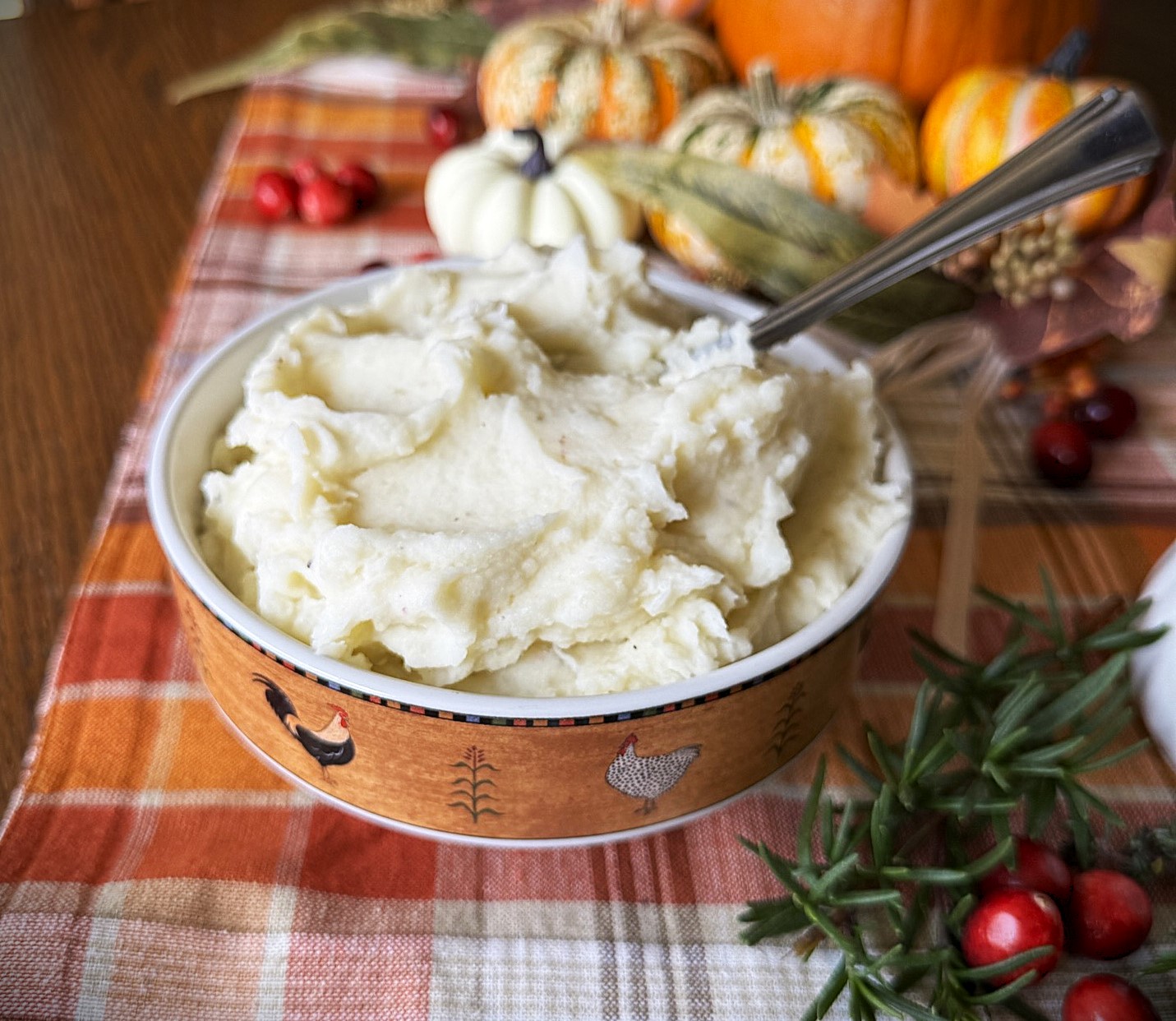
Homemade Mashed Potatoes
If you have real gravy, you can’t be making your mashed potatoes out of a box. And real mashed potatoes are easy to make. I use Russet or Yukon Gold potatoes. You can even use a mixture of both. I peel them and cut them into chunks that are roughly the same size, probably 1 inch by 1/2 inch cubes. But the size isn’t that important, as long as they are similar, so they cook at the same rate.
Cut potatoes oxidize fairly quickly, especially if you are doing a massive amount like I usually do on Thanksgiving. (Like 10 pounds or more.) But no worries, a quick rinse in cold water and that oxidation easily disappears. I usually give my potato cubes a quick rinse, place them in a pot, and add water just to barely cover the tops. I add salt, probably a teaspoon for 6 large potatoes, but don’t over-salt. You can adjust in the end, but you can’t take it out once they’ve cooked.
I simmer my potatoes for about 20 minutes, or until fork-tender. The time depends on the size of your cubes and how high you cooked them. Once done, I drain them at the sink into a colander and place them back into my hot pot for mashing. For about 6 large potatoes, I start with 1/4 cup unsalted butter, several cranks of a pepper mill, and a 1/4 of heavy cream. I use a handheld potato masher and mash away. I don’t personally use a mixer because it’s easy to over-mix and end up with potatoes that are more gloopy than creamy. I don’t mind a few small lumps in my potatoes, but if you want to rule that out completely, you can use a ricer. For the volume I typically do, that’s not practical. But for smaller amounts, it works like a dream.
Once I’ve mashed well and my butter and cream are well incorporated, I taste and adjust. Do I need more salt? More pepper? More butter? More cream? It’s all up to your personal preferences at this point. But please, TASTE THEM BEFORE YOU SERVE THEM. That’s one of the easiest ways to up your food game is by tasting and adjusting along the way, long before your guests take their first bite.
And there you have it, homemade gravy and mashed potatoes. 🙂 Once you’ve had the real thing, it’s hard to go back to the packet/jar/box variety. And now that you know how easy it is, you won’t have to.